

Install and Wire a Baseboard Heater
|
By Dave Rongey
Summary: Installing a Baseboard Heater Circuit: Wiring a baseboard heater thermostat and electric panel circuit then wiring connections for the installed baseboard wall heater. Instructions for converting baseboard heating radiant heating. © By: Dave Rongey |
Baseboard Electric Heaters for the Home
The electric baseboard heater uses convection to circulate air. When installed correctly and positioning under a window area, the electric
baseboard heater case causes air to flow naturally.
Cold air falls from the window area as the warm air rises from the heater, causing the air to gently circulate throughout the room.
The electric baseboard heater is the number one choice for low cost installation, and the quiet operation makes it the preferred heater for bedrooms. A wall mounted thermostat is recommended for optimum performance.Installing a Baseboard Heater Circuit
Skill Level: Intermediate to Advanced, Best installed by a Licensed Electrical Contractor. Work in electrical panels is not recommended for homeowners, non-experienced individuals or non-electricians.
Tools Required: Basic Electricians Pouch Hand Tools, electric drill, auger bits and extension cord.
Estimated Time: Depends on personal level experience, ability to work with tools and install 120 or 220 volt electrical circuit wiring and the location and access to the room for the electric heating unit.
Precaution: Identify the main circuit of the panel, turn it OFF and Tag it with a Note before working with the wiring or installing the 120 or 220 volt wiring and circuit breaker.
Notice: Installing an additional 220 volt circuit should be done according to local and national electrical codes with a permit and be inspected.
Considerations for Sizing Baseboard Heating Units |
|
| Voltage: 120 or 240 Volts | 240 Volt is typically more energy efficient and provides a lower energy bill compared to 120 volts because of even or balanced circuit utilization. |
| Dedicated Electrical Circuit | Most baseboard heaters will require a dedicated circuit. The size of the circuit will depend on the total watts that will be required. * |
| How much heat will be required | This depends on how well the room is insulated or what R-Value of insulation exists: Older Homes - Little insulation = 12.5 Watts per sq ft. Average Insulation: R-11 or 12 in walls, R-19 in ceiling = 10 Watts per sq ft. Fully insulated: R-11 or 12 in walls, R-30 in ceiling = 7.5 Watts per sq ft. |
| Adjustments to consider depending on your application | Ceilings above 8 ft - Increase the wattage by 25% for each additional 2 ft in height. Use a minimum of 100 watts when used in a bathroom. Use used as supplemental heat use 5 watts per square ft. In colder climates below 20 degrees F use the next larger size or up to 15 watts per sq ft. Size to the next larger size when calculations are mid way. |
| What size baseboard heater | Typical baseboard heaters produce about 250 watts per foot: 2 ft length = 500 watts 3 ft length = 750 watts 4 ft length = 1000 watts 5 ft length = 1250 watts 6 ft length = 1500 watts 7 ft length = 1750 watts 8 ft length = 2000 watts 10 ft length = 2500 watts |
| * Note: Always consult the manufacturers instruction manual for the specific heating unit you are considering. |
|
| Accessories: Programmable thermostats are available for most brands of electric baseboards, for precise temperature control and increased energy savings. A single pole or double pole bimetal thermostat is also available to install into either end of the baseboard heater. Since an electrical outlet may not be installed above a heater (National Electric Code), some brands offer a duplex outlet which can be installed in either end of the baseboard to meet local building codes. To switch between the baseboard heater and a cooling unit, optional controls are available as well. Inside corner connectors are available to fit various designs, such as corner window areas. |
Basic Baseboard Electric Heater Installation and Considerations |
|
| The following discussion explains a typical installation and also describes some problems to avoid as identified below. | |
 |
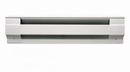
New Electric Baseboard Heater The design is simple, yet functional. The heat output depends on the length of the baseboard heater. The number of baseboards and length will depend on the size of the room. |
 |
Electric Baseboard Heater Thermostat Various thermostat controls are available to help regulate the desired temperature and provide optimal efficiency. Thermostat options may depend on the voltage that you select. |
 |
Baseboard Heater Electric Panel Circuit Baseboard heaters generally require a dedicated circuit depending on the size and voltage of the selected unit. Baseboard heaters work especially well with a 208/240 volt circuit which provides a balanced load compared to a 120 volt circuit. See the specifications for the brand that you are considering. |
 |
Baseboard Heater Electric Wiring A typical circuit is installed to the location where the baseboard heater will be installed. The wiring should be installed into the baseboard heater using a protective bushing or cable connector. The cable shown here lacks the 1 inch required amount of cable sheathing to enter inside the connection enclosure and the ground wire has been cut too short. |
 |
Baseboard Heater Wiring Connections This example shows how the power is brought to the heater using a surface raceway. Ideally the baseboard heater should not rest on the floor or carpeting such as shown in this photo. |
 |
Baseboard Heater and Thermostat A thermostat mounted at either end of the baseboard heater provides temperature control, however a wall mounted thermostat will be more efficient and may control more that one heating unit depending on the calculated load of all units and the load capacity of the wall thermostat. |
 |
Baseboard Wall Heater Installed Baseboard electric heaters provide an easy solution for heating most rooms. Consult the manufacturers specifications and installation information for the unit you choose. |
| NOTE: Flammable materials must be kept 12 inches away from baseboard heaters. See your installation manual for complete details. | |

| <<- Electrical Wiring for Wall Mounted Heat Pumps | Outdoor Home Electrical Repairs->> |
| Baseboard Electric Heater Top of Page - |