

It May Be Time to Change Batteries or Replace Your Smoke Detectors
If the alarms in your residence are more than 10 years old, consider replacing them. Depending upon the building codes in your community, consider upgrading them to a combination smoke and carbon monoxide alarm. Consult a licensed professional to install and test your alarms.
Replace and Upgrade your Smoke Alarms Every 10 Years
Did you know that the National Fire Protection Association (NFPA) urges replacing home smoke alarms after 10 years? The NFPA also encourages homeowners to upgrade their smoke alarms to a combination smoke/carbon monoxide (CO) alarm for double protection.
Licensed professionals can help you determine the age of the smoke alarms in your home and if they meet code requirements. Aging smoke alarms do not operate efficiently and often are the source for nuisance alarms. Older smoke alarms are estimated to have a 30% probability of failure within the first 10 years. Newer smoke alarms do better, but should still be replaced after 10 years. Unless you know that the smoke alarms are new, replacing them when moving into a new residence is also recommended.
Smoke alarms, when properly installed
Smoke detectors give the early audible warning needed to safely escape from fire. This is critical because 85% of all fire deaths occur in the home, and the majority occur at night when most people are sleeping. Each year home fires account for thousands of deaths some which may be avoided if the home was equipped with functioning smoke detectors.
Recent statistics about Smoke Detectors
94% of U.S. homes had at least one smoke alarm. Sadly 40% of the home fires reported to U.S. fire departments and 52% of home fire deaths still occurred in homes where there were no smoke alarms.Half of the deaths from fires in homes equipped with smoke alarms resulted from fires in which the smoke alarm did not sound--usually when batteries were dead, disconnected or missing.
Simple steps like maintaining smoke alarms and replacing older ones help diminish the possibility of fire deaths in the home, says John R. Hall, Jr., NFPA's assistant vice president for fire analysis and research. Smoke alarms in the home are largely responsible for the decreasing number of home fire deaths over the last decades.
The NFPA offers the following smoke alarm safety tips:
- Install new batteries in all alarms once a year or when the alarm chirps to warn that the battery is dying.
- Test units at least monthly. Test the units using the test button or an approved smoke substitute.
- Clean the units, in accordance with the manufacturers' instructions.
- Do not use an open-flame device for testing because of the danger the flame poses.
- Smoke alarms should be placed outside each sleeping area and on each level of the home, including the basement.
- In new homes, smoke alarms are required in all sleeping rooms, according to the National Fire Alarm Code.
- Alarms should be mounted on the wall 4-12 inches from the ceiling; ceiling-mounted alarms should be positioned 4 inches away from the nearest wall. On a vaulted ceiling, be sure to mount the alarm at the highest point of the ceiling.
How to Wire Smoke Detectors
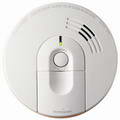 |
Summary: To ensure that your smoke detectors are reliable it is advisable to replace smoke detectors every 10 years, in fact the National Fire Prevention Association recommends it.
© By: Dave Rongey |
Wire and Upgrade Smoke Detectors
Time to Change You Smoke Detectors?
If the smoke alarms in your residence are more than 10 years old, consider replacing them. And depending upon the building codes in your community, consider upgrading them to a combination smoke and carbon monoxide alarm. Hire a licensed professional to install and test your alarms.
Replace and Upgrade Your Smoke Alarms Every 10 Years
Did you know that the National Fire Protection Association (NFPA) urges replacing home smoke alarms after 10 years? As leaders in home safety, the NFPA also encourages you to upgrade your smoke alarms to a combination smoke/carbon monoxide (CO) alarm for double protection.
NEW STANDARDS - UL 217 and UL 268
The new editions of UL safety standards for home smoke alarms and smoke detectors have performance-based technology requirements, enabling products to better distinguish between smoke from cooking and smoke from a potentially life-threatening fire. These improvements will help minimize cooking nuisance alarms, which is the top reason why people disable their devices.
IMPORTANT:
It is important to note that since there have been reliability issues with ionization type smoke alarms & some states have banned them. I.A.F.F. recommends photoelectric type only. The new smoke detectors which meet ULs revised 217 & 268 requirements are the photoelectric type.
Replace Your Old Smoke Detectors with Photoelectric Type
Make sure to replace your old smoke detectors with smoke detectors with UL 217 and UL 268 enhancements.
For more information go to: The Smoke Detectors Organization
 |
|

The Safest Way to Test Electrical Devices and Identify Electric Wires!The Non-Contact Electrical TesterThis is a testing tool that I have had in my personal electrical tool pouch for years, and is the first test tool I grab to help identify electrical wiring. It is a Non-contact tester that I use to easily Detect Voltage in Cables, Cords, Circuit Breakers, Lighting Fixtures, Switches, Outlets and Wires. Simply insert the end of the tester into an outlet, lamp socket, or hold the end of the tester against the wire you wish to test. Very handy and easy to use.
The Quickest Way to Check for Faulty Electrical Wiring!The Plug-In Outlet TesterThis is the first tool I grab to troubleshoot a problem with outlet circuit wiring. This popular tester is also used by most inspectors to test for power and check the polarity of circuit wiring. It detects probable improper wiring conditions in standard 110-125 VAC outlets Provides 6 probable wiring conditions that are quick and easy to read for ultimate efficiency Lights indicate if wiring is correct and indicator light chart is included Tests standard 3-wire outlets UL Listed Light indicates if wiring is incorrect Very handy and easy to use.
Strip Off Wire Insulation without Nicking and Damaging the Electric Wire!The Wire Stripper and Wire CutterMy absolute favorite wire stripping tool that I have had in my personal electrical tool pouch for years, and this is the tool I use to safely strip electrical wires. This handy tool has multiple uses: The wire gauges are shown on the side of the tool so you know which slot to use for stripping insulation. The end of the tool can be used to grip and bend wire which is handy for attaching wire onto the screw terminals of switches and outlets.. The wire stripper will work on both solid and stranded wire. This tool is Very Handy and Easy to Use. |
||


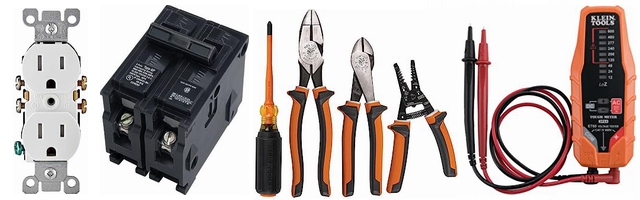
Residential Electrical Parts and AccessoriesLight Switches 120volt Outlets Circuit Breakers Electrician Tools Voltage Testers |